The Power Of Song

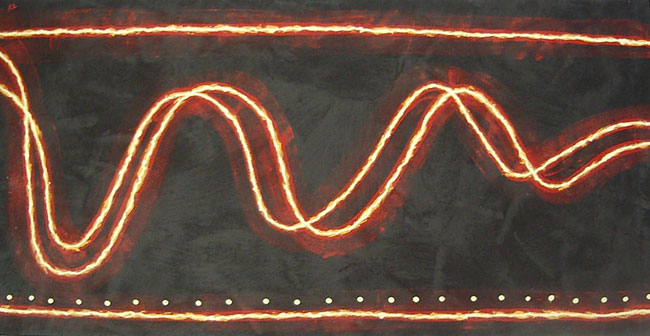
songlinesBy singing the songs in the appropriate sequence, Indigenous people could navigate vast distances, often travelling through the deserts of Australia’s interior.

I’m no expert on the science of sound vibration, but I know absolutely the power of it. The palpable energy of light, love and peace present after a time of Kirtan. The way a singing bowl brings people into the space of one heart. The gracious space that lingers after chanting aum. Being swept into another dimension by listening to Gregorian chants.

Why such impact? It’s in the nature of water and we are mostly water. I had thought up to 98%, but it turns out to be between 70% and 80%. Still it’s a lot of water. And like all water our bodies are susceptible to vibrational influences. Energetic influences can agitate our waters or calm them and bring us into a place of peace. Through the power of vibration we  can join our energy with that of the universal web. Indigenous peoples throughout the world have known this and worked with this knowing. We are aware of the stories that come from the aboriginal peoples of Australia, we may be less aware of the stories that come from Ireland.

Bird Song. Soul Song.

When the Soul wants to experience something,
she throws an image before her
and steps into her own experience.
Meister Eckhart

starlightWe come to this life with sacred intention. To manifest our unique expression of light. Of love and joy and laughter. Of peace. It’s a promise we make with our soul as she throws our image before her. It is our soul song.

As babies and small children we held this knowing, but through years of enculturation it tends to get lost and we forget why we are here. Why we are really here.

The bird never loses this knowing. They sing from their very essence, woven in the web of all sacred life. Woven, as are we.

Indeed, as Mother Dawe commented on the previous post, may we all sing our song because we can. Because we have one to sing.

Bird Song

One day in a private session one of my teachers asked me why birds sing.

Yes! This was an opportunity to impress her. To let her know I had paid close attention to her teachings over the years of working with her. To share from my deep well of birds singingaccumulated wisdom. So I reflected for a moment on her question, took a long, slow breath. And launched.

Well. I rambled on at length about the web of all life and the sacred vibration that weaves us all together. About how everything is connected and interdependent. How the bird song is part of the energy that awakens the Earth each spring…blah, blah, blah. When at long last I was finished she smiled one of her smiles that lives next to laughter, and said graciously, “Yes. All of that is true. But it is not the answer I was looking for.”

It took me a year to find that answer. And of course it only came when I was ready to receive it. After four weeks in Ireland this past summer searching for answers. After months  of gentle yet persistent encouragement from my teachers. After finally surrendering fully and unconditionally to this spiritual journey of ancient discovery, knowing that this is the work of my soul. After all that, the answer came from the pages of a book during my research this winter. It came as an affirmation.

A bird sings because it has a song.

What Am I Doing Here?

My sister gave me Paulo Coelho’s new book, Aleph. It’s a good book. But the first page blew me away. As I travel this path, this soul promise of working with what Anthony Murphy   calls” the original and divine race of Ireland” …  well, let me just share what Coelho wrote.

Oh, no, not another ritual! Not another invocation intended to make the invisible forces manifest in the visible world! What has that got to do with the world we live in today? Graduates leave university and can’t find a job. Old people reach retirement and have almost nothing to live on. Grown-ups have no time to dream, struggling from nine to five to support their families and pay for their children’s education, always bumping up against the think we all know as “harsh reality.”

The world has never been as divided as it is now, what with religious wars, genocides, a lack of respect for the planet, economic crises, depression, poverty, with everyone wanting instant solutions to at least some of the world’s problems or their own. And things look only bleaker as we head into the future.

What am I doing here, trying to make my way in a spiritual tradition whose roots are in the remote past, far from all the challenges of the present moment?

What am I doing here?
I’ve asked myself this question so many times. But I don’t ask it anymore. And it turns out birds had the answer…

A Daunting Drive

Coming around a blind curve at 100 KPH, the legal limit on many of Ireland’s narrow winding roads, and finding yourself face to face with a tour bus significantly wider than the oncoming lane can be a bit daunting. At this point the center lane, if there iscoast road 4 cropped one, holds no meaning. There are no shoulders and the vegetation now brushing the side of your car most probably conceals a substantial stone wall. Add to that driving from the right side of the car on the left side of the road. Ask anyone who’s been there, motoring in Ireland is an adventure. Why don’t they widen the roads?, is a frequent question from fellow travelers shaken by a recent encounter.

In fact the Celtic Tiger brought with it a significant surge of road construction and now dual carriage ways (double lane highways) bypass many villages. While I appreciate the advantages of fast travel from point A to point B, I go to Ireland to savor time, not save it. And what is lost for me is a slow crawl through narrow village streets, delivery trucks double parked, garbage trucks stopping every few feet to empty trash containers, and pedestrians crossing wherever convenient.

But in much of Ireland the roads remain as they have for centuries. Yes, they are frequently resurfaced, but they are rarely if ever widened or straightened. The roads are shaped by the land, the farms and fields which are small enough without carving out larger lanes. Those stone boundary walls are not easily moved, physically, socially or emotionally. And the Irish don’t seem to find the narrow winding roads much of an impediment. After all the speed limit is 100KPH.